
A Simple Guide To Holding Your First Staff Meeting

Your First Staff Meeting: Topics to Cover and What to Discuss
Nice work! You got the job, and now it’s time to hold your first staff meeting as the team’s new manager. You should be excited and proud of your accomplishment. And, it is ok to be nervous. Every new leader struggles at the beginning; it takes time to get the hang of things. But, as the old saying goes, first impressions are important and you do want to make sure your first team meeting as manager leaves a positive impact on your new employees.
Whether you were brought in from the outside, or you were a peer before taking a promotion to the corner office, you are now the boss. And, either way, your new employees will be very interested in what you have to say so use this time wisely and to your advantage. Kicking things off right with your new staff is an important first step, so schedule sufficient time to hold a good discussion with your new team. To help you get started, here are 9 tips for holding your first meeting with your new staff:
1. Do Your Homework
Your first meeting with your new employees should really start before the event itself. Whether as part of the onboarding process, or through a short discussion with your own boss ahead of time, try to gather some key details about your new team before you actually meet them. Are there any existing issues that you should know about? Has the team recently earned praise for a job well-done? Has there been a turnover problem? Are there any circumstances to your predecessor’s departure that you should be aware of? Has the team been there a long time, or are most employees relatively new?
Collecting some initial intel on your new team is helpful in two ways. First, it can help you avoid pressing any “hot buttons” from the start, should any exist. Second, it allows you to shape some of the comments and information you share with your new team.
You don’t need to outwardly discuss any of the information you gathered, but having it in the back of your mind when you are first meeting your staff will certainly give you a little bit of context behind the current work environment you are entering.
2. Set an Example… And That Great First Impression
Now that you’re the boss, remember one simple yet very important thing: to be a great manager you must also be a great leader. And, great leaders are fair, honest, transparent, tough when they need to be, compassionate… as well as professional.
In order to make a great first impression with your new team, follow and demonstrate these principles. Additionally, you should arrive early, dress professionally, have a positive attitude and be confident. Doing so will go a long way towards earning their trust and kicking things off the right way.
Other things to keep in mind that will help you make a great first impression on new employees:
- Successful managers build healthy relationships with employees. Start doing this on Day 1.
- Your role is to create an environment of success where your employees’ talents may flourish.
- A positive and calm attitude is infectious, and it starts with you.
- You do not need to have all the answers; you just need to help find solutions.
- All great things take time. Focus your staff on the importance of making incremental progress.
- Be the leader that you, yourself, would want to work for
RELATED: 14 Things That Only the BEST Leaders Do
3. Get A Little Personal
You don’t need to tell your new employees about that time you broke your arm when you were in middle school. But you certainly can accelerate the time it takes for your new staff to get comfortable with you by offering a little personal information during your first meeting.
Here are a few examples of what you might want to share with your employees:
- Where you were born
- Information about your family and children
- Identify some of your hobbies
- Mention your favorite sports team or musician
- Your passion for trail running
Telling your new staff a little bit more about who you are not only makes you relatable, but it also helps your employees identify things they may have in common with you. There will be plenty of time to tell them the story about how you broke that arm in middle school later; for now, focus on giving them a basic outline of who you are.
4. Briefly Introduce Your Professional Background
During your first introduction meeting with your new staff, provide an overview of your career progression to get that point. While you will want to avoid a long review of your resume, take your new team on a brief tour of your career and academic progress, giving your employees a chance to learn about your credentials, skills and relevant experience.
Providing a brief overview of your experience is another great way to earn trust as well as to find common ground with your staff, some of whom may have had similar work and academic experiences as you. Additionally, giving your new employees an understanding of your background and the related experience you bring to the role can calm nerves in what can sometimes be an unsettling time for them.
Some examples of information you might want to share can include:
- Academic achievements / university
- Your first job and what it taught you
- Prior companies where you may have worked
- Any special projects or interesting experiences that helped shape your career
- Something you consider was a personal highlight to your career up that point
- The best career advice you were ever given
Although you may have just been promoted into the position and your new employees already know you, chances are there are some details about your professional background that would be of interest to everyone.
5. Consider an Ice Breaker
Some people love them; others do not. But they can serve a purpose and help settle peoples’ nerves – both your own and those of the people staring back at you wondering who this new person is at the front of the room.
Whether you plan to do it, or have on in mind at the ready should it be a tough crowd, consider a simple New Manager Ice Breaker that will help get your staff talking and engaged in your first real discussion with them.
6. Outline a Basic Vision for the Team
While you want to avoid introducing immediate changes and rushing to make an impact, you can be open with your new team and should share some of the goals you have in mind. Your introductory meeting with your team marks an excellent time to outline some of these ideas and your basic vision for the team. Even if you are new to the organization as a whole and are uncertain where the team stands today, more than likely you have a big picture view of what you would like to see the team become or where you’d like it to go.
Examples may include:
- Making your customers feel like they should never go anywhere else
- Delivering superior service to clients
- Wanting to build a strong sense of teamwork among your staff
- Ensuring everyone has opportunities to develop their career
- Building a work environment that by itself attracts new applicants
- Making sure employees go home safely to their families every night
Your new staff will be interested to hear what you want to see out of the team, and where you might be leading them. Keep it general and thematic in nature. Briefly touching on your initial vision may also invite ideas from employees on how to get there.
RELATED: How to Create and Communicate Your Vision
7. Focus On…
Settling into your new role is not just about you. A key element of your transition into a management position is getting to know your new surroundings – both your work environment as well as those in it. In your first group setting, focus heavily on the staff. They need to adjust to your leadership style, too.
Devote time to listening to the team and to deliberately ask questions that enable you to obtain some vital details. Engage your new employees and ask for them to introduce themselves briefly, including their own backgrounds.
Additionally, ask questions that give you an understanding of the team’s current state. That is, the current opportunities, challenges, issues and possibilities. The questions you ask should help you evaluate things like morale, workload, skills and barriers. While these details will certainly emerge over time, and even if you already have a good understanding of the challenges and opportunities, open discussion about it with those involved is always a beneficial activity.
Examples of questions to ask employees as a new manager can include:
- How would you describe the things we do really well?
- What makes us better than the competition?
- How would our customers or stakeholders describe us?
- What obstacles are we facing in general? Right now?
- What is the biggest challenge this team faces?
- What has kept you here as part of this team for as long as you have been here?
- What would enable this time to take it to the next level?
- How can I help make things better?
Open ended questions like these facilitate a healthy discussion that can reveal a number of themes that you can use to map out your first activities as the new manager. Just be prepared for the answers.
Need Help Getting Started?
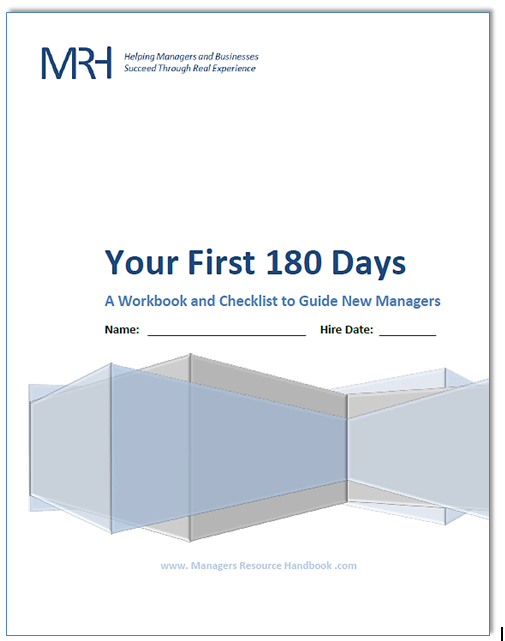
Your First 180 Days Workbook, Checklist and Guide – 2nd Edition!
Updated and Expanded! Your First 180 Days – 2nd Edition is a workbook designed by our experts to walk you through your first 6 months as a new manager. This 66-page guide is packed with new manager tips and is broken into a 32 step-by-step sequence that helps you learn faster and get organized during this exciting time of your career. Simply print it out, mark it up, and make it your own! From managing tasks, to meeting metrics and mentoring your staff – it’s all here.
[ezcol_1half]Here’s What You Get:Length: 66 Page Workbook
Format: .PDF
File Size: 581Kb
Price: $21.99
Download Link Made Available After Checkout
Buy Now
Get a Preview:
[/ezcol_1half] [ezcol_1half_end][/ezcol_1half_end]

8. Establish Some of Your Expectations and Ground Rules
Because your employees will be hyper-focused on the new person standing in front of the room, your transition period makes it an especially good time for you to introduce some of your expectations for the team. It also serves as an ideal time to lay a solid foundation for what you expect in terms of employee performance.
As part of this, you should discuss some of the basic things that are important to you, such as communication preferences, working hours, and how you wish to handle vacation time and absenteeism. A lengthy list is unnecessary for your first staff meeting, but at least highlight a few key points to give employees an idea of those things you value and that are important to you.
5 Other Tips for a Success New Manager Introduction Meeting:
- Be prepared to answer questions – simple and tough.
- Having a new boss can be awkward for your staff, be patient.
- Be yourself; doing so will help you staff figure out how to interact with you
- Don’t try to solve problems, focus on identifying them in your own mind.
- You don’t need to hit on every detail; for now, focus on covering the basic and then go deeper in subsequent staff meetings.
9. Outline What is to Come
At the end of your first staff meeting with your new team, conclude by informing them what they can expect over the next several weeks or months. Briefly explain the plans you have in the near-term, and how they will involve the team. Giving your new employees a sense of what is to come helps further align expectations and serves as a basis for planning and mapping out your next steps.
Examples of things to mention can include:
- Setting up one on one meetings with each employees
- Detailed project reviews
- Setting or reviewing employee performance goals
- Learning and understanding the team’s processes
- Speaking with current clients and customers
- Your own transition from prior position / location to new role
The best time to line up your team behind your plans for the future holds is when they are listening to you for the first time.
Holding Your First Staff Meeting
Overall, you first meeting with your staff as manager marks a very important milestone in your relationship with your new employees. Use the time wisely. Get to know your team and identify the challenges in front of you. Additionally, tell your employees a little about yourself and how you want to see the team work together. The more you communicate with your team up front, the faster you will align expectations and help your staff to get to you know as a leader. While your transition into the role of a manager will take some time, start by making a great first impression and having an open and positive conversation with your new staff.