
The Top 5 Challenges Facing The Modern Manager

Management Challenges and Solutions For Today’s Organization
Over the past few weeks, I’ve been participating in a significant hiring binge by my firm. Having interviewed candidate after candidate, the process of filling more than 20 new positions is extremely fast-paced, if not frantic, considering how important hiring decisions are. How do I properly assess a candidate’s skills when I am meeting with several applicants in a single day? Trying to keep the names and resumes straight is no simple task when you’ve sat through multiple interviews over the course of a week and asked each candidate the same questions. With every applicant, I find myself asking the same questions. How well will the candidate fit with the existing team? Do they really want to work here, or do they just need a job?
Please Answer This Question in Support of our Management Research!(Results Will Display After You Answer)
NEW! How would you describe the work/life balance at your place of work?
|
From negotiating salaries to selecting people who will fit the business well enough to stay a while, I came to the realization that hiring the right people is just one of the many difficulties today’s managers face. What is modern management? What does it take to succeed as a boss in a company these days? After a full day of interviewing candidates, I found myself sitting back in my office to answer these questions. I came up with the following list of five key management challenges that face today’s business leaders as well as some of the solutions I have used to tackle them.
1. Maximizing Scarce Resources
It was in the economics class in my MBA program where I learned to associate the word ‘scarce’ with the word ‘resources.’ In virtually every business case I read as a grad student, my analysis boiled down to the same thing: an organization struggled to balance its limited resources with its pursuit of lofty goals. In the never-ending fight to get just one more employee or seeking extra funds for a piece of equipment, resources are never enough. In many cases, these requests clash directly with the need to be profitable, competitive, and cautious.
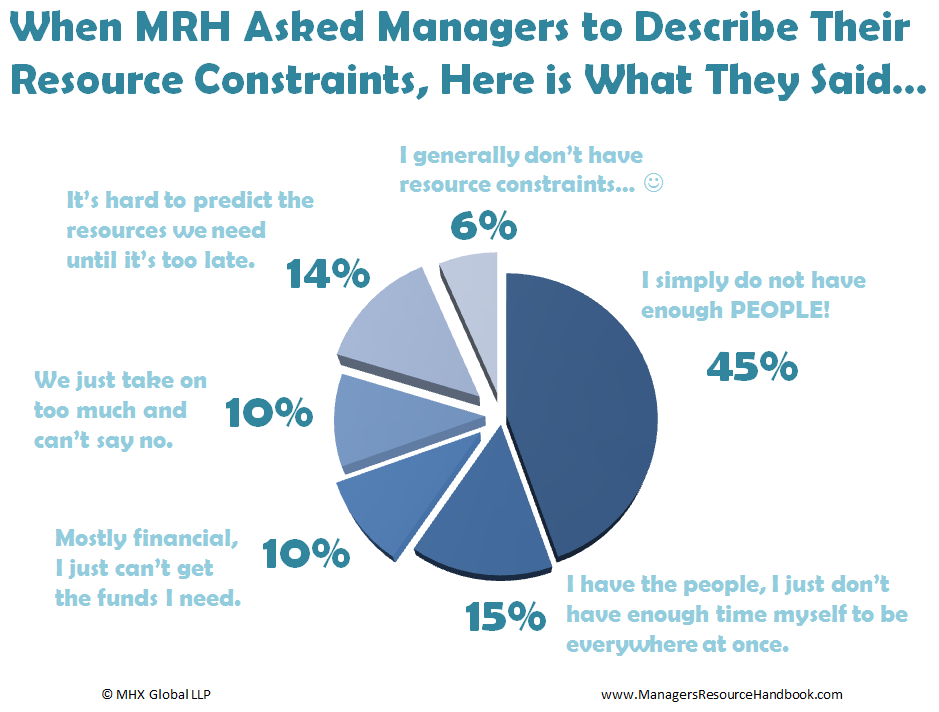
Modern businesses are met with heavy competition every day. It could be the small coffee shop trying to keep up with a global chain across the street, or a multibillion euro corporation in Germany competing against a competitor from Japan for the same contracts. In any case, management and leadership teams are routinely sandwiched between the lack of sufficient resources to do what they think might be best, and the task of generating fantastic results. A colleague of mine once referred to this as the ‘ultimate management paradox.’
RELATED: How to Justify Additional Staff
If you’re really struggling with this balancing act, the best advice I can offer you in terms of resource management is to use data to drive your actions. Don’t take ‘no’ for an answer when it comes to investing in another employee or a piece of equipment which has a clear and undisputable positive payback. Collect your data and present a case.
2. Remaining Relevant to Your Team and Business
Amid splashy changes in technology, managers who have been in leadership roles for say, 20 years or more, might find it difficult to keep up with the rapid pace of change in the work place.
For a manager who started his or her managerial career prior to the mid-1990s, for example, think about the changes that have transpired since those days: the proliferation of basic cell phones, followed by introduction of text messages. Then came the smart phone and now we have tablets. It’s the entire office in your pocket. Why do people still list FAX numbers on their business cards?
Or, think about how paper filing systems have been replaced entirely by mass electronic archiving of information in web-based applications. Or the cloud. Paperless systems are just one of many expectations of a modern business as a path to cut down on cost and become more environmentally friendly.
RELATED: 7 Ways to Cut Cost in Your Business
I haven’t been managing for quite that long, but sometimes I feel a little antiquated myself. I have an occasional preference for actual paper files that I can pull out of my desk to escape a screen for a little while. Sometimes, it just feels good to have a piece of paper to write my notes on.
The point is this: Technology is accelerating the pace of change in the workplace faster than ever, and as entry-level employees are being added to the workforce every day, experienced people managers must keep their own skills fresh in order to lead their teams effectively. Consider the practice and training it takes for managers just to keep up. To make matters even more challenging, keeping up with technology trends is not even an option; in some cases, it is all the employees joining the today’s workforce may know.
RELATED: Technology’s Impact on Business
3. Finding and Retaining Good Employees
Modern business is not just about competition for customers, but also competition for employees. As I examine resumes for the candidates I have been interviewing in recent weeks, I can’t help but notice that some have held three positions at three different companies for just about 12 to 18 months each. They have moved around, and tried different things, and some have already experienced a layoff.
The salaries they have been requesting are significant. With just 5 years of experience, no advanced degree and few significant accomplishments, some are seeking compensation in the neighborhood of what my 15-year employees with advanced degrees and a long list of accomplishments are earning. How do you compete with this?
RELATED: 10 Free Employee Retention Strategies
It’s not all about money, of course, but today’s workforce is after opportunity, advancement and overall satisfaction. But they also want stability, excitement and a place where they can flourish. With higher and higher pay being offered down the street, and something more interesting popping up in the next city, holding onto employees – particularly the good ones – is a difficulty shared by all managers today. For these reasons, we must find more inventive ways of keeping employees happy and engaged, while balancing the tight controls of modern corporations.
For what it’s worth, I have found that offering various perks and incentives, such as team breakfasts and training opportunities can go a long way towards keeping people happy and motivated. But employee engagement and retention certainly does take more than a cup of coffee. Employee retention requires managers take an active interest in their employees’ careers as well as continually make efforts to motivate employees to stay.
4. The Gift of Responsibility …Without Authority
Within the modern, post-financial crisis corporation, decision-making is frequently held in the upper ranks of an organization. Even though you might be a manager, a second level manager, a director or even a vice president, very few decisions are fully bestowed upon those responsible for getting the results.
The ‘let me get approval’ loop built into the mix is not an entirely new, nor an unreasonable concept. But it is noteworthy because the pace at which business continues to accelerate is making it difficult for managers to react and move quickly enough.
Add to this the fact that today’s managers often have tremendous responsibility and expectations levied upon them, in terms of productivity, innovation and financial performance. A perpetual need for approvals and buy-in from the top to ensure things are in line with expectations often places department supervisors and team leaders in a tough spot – they have numerous responsibilities, but often lack the authority to just ‘go and do.’ The result: frequent changes in direction, delays and frustration by seasoned managers who still need to wait for a go-ahead on what they know is the right thing.
One of the few reliable ways you can combat this trend is simply to be smart with your up-front planning and communication to senior leaders. To expedite the whole process, let them know what you plan to do under a few different scenarios, then follow through. In other words, tell them that if your customer does A, you will do B. If the customer does C, you will do D. If the customer does X, you will do Y. Rather than ask when an urgent decision is needed, get buy-in and alignment on strategy and decisions up front, and then communicate the path you ended up taking once the activity is complete .
5. The Overabundance of Competing Metrics
It seems as though you cannot be considered a modern business these days unless you have enough metrics to measure every single aspect of your business.
My firm, for instance, recently began tracking waste – solid vs. recycled, natural vs. synthetic, as well as the total cost recovery we get from selling it to a recycling outfit. Certainly, it’s with good intention and emphasizes a commitment to minimizing environmental impact. But if we mesh the fact that we have 5 metrics alone for waste, you can imagine what the total list looks like when you add in everything else: productivity, quality, inventory, customers, sales and staffing statistics.
Don’t get me wrong, metrics are a very good thing and they help you identify trends and problems that need to be fixed. But, the tendency for businesses to measuring every aspect of an operation with a swirling world of numbers, percentages and red-yellow-green charts can become dangerous.
Too many metrics create organizational conflict. In other words, how I am measured (that is, the metrics I am responsible for achieving) may not be aligned to how you and my other peers are measured. Thus, what might motivate one part of an organization, has no bearing on the decisions of another, resulting in internal conflict. The misalignment of goals and measures kills true productivity because everyone is pulling in different directions.
Oddly enough, this returns us to my first point. The impact of excessive measurement only heightens the competition for those same scarce resources.
The solution to this very common problem is actually quite simple. Take a long hard look at what is really important to your organization’s success. I mean, REALLY important. A list of more than 5 things is pushing it. Identifying how everyone in an organization aligns to those goals will be the difference between an organization in which everyone pulls against one another and a company in which everyone rows in unison in the same direction.
Solving Today’s Management Challenges
We all know the demands on today’s managers and business leaders are high, as they should be. It takes a lot of hard work for a business to success in today’s economy. And while it may seem sometimes that the challenges are too tough, too daunting and too complex, we at MRH have seen them time and time again. Our goal here is to help you tackle those problems and find solutions for your business. If you have a need where MRH expertise can help, please CONTACT US.
Looking For More On Common Management Challenges and Solutions? You Might Also Like:
25 Ways to Manage Crisis in the Workplace
Managing A Layoff – A Four Part Series
7 Ways to Reduce Cost In Your Business
15 REAL Ways to Manage Your Time as a Busy Boss
The 5 Things That Tell You It’s Time to Restructure
What To Tell Your Team After Someone Was Fired
Pingback: Management theories from Roman slave-owners – Jerry Toner – Aeon - Trendingnewsz.com
The notes are fruitful for me.
Lovely and educative stuff.
Overabundance of competing metrics!! You are spot-on! One of the minuses of technological advancement in software engineering, I suppose. I have resolved to use the simplest, so everyone can follow and understand what I do more easily!