
Improving Employee Productivity

21 Expert Tips for Increasing Workplace Productivity
If boosting your department’s throughput were as easy as flipping a switch, every boss’s job would be infinitely simpler. Unfortunately, that’s far from reality. Further, as an old colleague of mine used to say, “Asking people to work harder is not a solution.” In the proven strategies that follow, we will illustrate how increasing workplace productivity is the result of the entire ecosystem you build around – and within – your organization.
The concept of productivity boils down to one basic thing: time that does not add value is time lost. And, as the old saying goes, time is money. As we go through the tips that follow, understand that increasing employee productivity is really about optimization – reducing down time, improving efficiency, working smart not hard, and cutting out the things that have little true impact.
No one thing can increase a team’s productivity; there is no switch. Rather it is the combination of the tweaks and adjustments you make as the leader that yield higher output. Enough of the chit chat, let’s talk detailed strategies for improving workplace productivity, shall we?
1. Cut Out Undeniable Waste
Alright, it may sound obvious, but it needs to be said. Far too many managers erode productivity by burdening their teams in ways that waste precious energy. Now, to be fair, every job in every organization comes with administrative duties. Still, there is a balance between valuable administrative activities and wasted time. If you want to improve employee productivity, the first question you must ask is What can I eliminate? Be aggressive with your answer!
Here are some examples that may resonate with you:
- Weekly report from each employee? If you don’t read them weekly, then don’t ask for them weekly. Maybe monthly will do.
- Do you need that many metrics? Metrics should drive behavior. If you are not acting based on a given metric, don’t waste time tracking, following, recording or discussing it.
- Approval forms? Do you really need employees to fill out a form to request food for a working lunch? The 10 minutes it takes an employee to locate the form, fill it in and bring it to you could be solved by a quick email, or better yet, a 30-second hallway conversation.
While a list like this could go on and on, ultimately your objective is to pave a clear path that allows employees to focus as much of their time on value-added work.
2. Understand What You’re Doing Now, Then…
Wasted time can be easy to spot if you pause to look for it. An excellent method for identifying areas of waste in the workplace is to set up a simple time tracking system to log where employee time is going.
It’s simple math, really. Given the fixed amount of time your team has available each week, your employees are either working on important things, or they’re spending precious time on non-value-added tasks.
Additionally, tracking time also gives you a solid database of information for planning assignments and due dates the next time around.
3. Clarify Goals, Scope and Objectives
To supercharge productivity and get the most out of your team, you must clearly define the mission. Defining the expectations and objectives of a given assignment will prevent employees from going down the wrong path, overthinking (or under-thinking) a specific problem, and otherwise missing the mark.
If you want the employee to deliver the result you have in your mind, it’s up to you as the manager to make those expectations and that vision known. Taking a few extra moments to make sure instructions are crystal clear can avoid hours, days or even weeks of wasted effort.
Some way to clarify the scope and objective of a given assignment may include:
- Describe the type of output that’s needed. Are you expecting a detailed report, a 3-page presentation, or just an email with bullet points?
- Define a timeline for the employee – “Don’t spend more than 2 days on this.” or “It will take several weeks for you to get to the necessary level of detail.”
- Describe the activity needed – “Please set up a meeting with James and build a detailed schedule that can be shared with the client”
- Ask the employee(s) to describe their approach to your request to confirm they understand what is being asked of them.
Clarifying expectations reduces the potential for misguided or wasted effort.
4. Create a Task List…
When there’s a lot going on, it’s easy to get overwhelmed and lose track of everything on your team’s plate. And, the last thing you want to do when looking for ways to improve productivity is to expend time brain power trying to remember it all.
There’s a simple solution here: write things down as they come up. Make lists of tasks – in your staff meetings, at the beginning of the week, or at the end of the day to prepare for the next – that you and your employees can refer to. As additional tasks emerge, and new requests are received, simply add them to your team’s list.
A second convenience offered by making list is optimizing the use of time. Few people will start a large task 30 minutes before they call it quits for the day. However, many employees will fill that time with things they can get done easily, like filing an expense report, scheduling a meeting for the next week, or reading a document that’s been awaiting his or her signature. An easy list of tasks to refer to allows people to fill a fixed time slot with items that can be completed within that span.
5. … And Visualize Workloads for Everyone
When employees are unclear about responsibilities, it usually results in duplicate effort. Or, it can result in tasks falling between the cracks when one employee assumes someone else has the ball. Both are forms of waste.
Our prior point discussed the value in creating a task list. Whether you publish the task list to the team via a simple email or elect to use a more elaborate approach such as a white board in the work area, visualizing work, priorities and assignments makes it clear who is working on what.
In addition to organizing your employees’ workload, visualizing workloads has three added benefits.
First, when an employee sees a list of assignments next to his or her name – for all to see – it tends to encourage a little more hustle from each staff member, ensuring things are done on time.
Second, when individuals complete one task, having a well-defined list at their fingertips enables that individual to move onto the next item immediately, without having to think about what’s next.
Third, it gives you as the manager an ability to see which employees may need help, which employees could use more work, and who is performing well.
6. Plan for the Unplanned
In every place of work, every organization and every team, nothing goes perfectly. Even airlines, who operate on strict schedules, must accommodate weather delays, mechanical issues, and the occasional late arriving suitcase.
Estimating time and durations is not easy, even with the best laid plans. While tracking time as discussed in an earlier point can reveal where energy is going, productivity is a function of working efficiently as much as it is a function of managing throughput with a fixed amount of capacity.
In order to boost staff productivity you must manage expectations of others. If, as a manager, you tend to overcommit, the work continues to pile up. As a result, employees will rush to meet deadlines and careless mistakes will no doubt happen. Ultimately, additional time will be lost when an employee must go back and fix their errors made in haste.
Of course, this is not to say you should allow employees to work at a relaxed pace, but merely that something unexpected will inevitably arise and you must factor this reality into the commitments you make.
7. Instill a Sense of Urgency
It’s easy to notice when you’re in a work environment that lacks a sense of urgency. There are a lot of casual conversations going on (say between two or three employees for an entire hour on a given day), there are more excuses for why work is not being completed than the work itself, and worst of all, employees do not appear to feel the need to do anything differently.
Naturally, a sense of urgency increases employee productivity. But how do you create this? A sense of urgency is really the result of employee accountability – an overarching expectation that employees must perform.
Here are a few simple ways to drive this accountability and a sense of urgency:
- Ask employees for commitments and due dates; write them down and follow up.
- Lead by example. The speed and pace at which you work will carry over to your employees.
- Make things important – employees take more care in something when they understand why it is needed.
- Interrupt lengthy non-work-related discussions during work hours.
- Link performance and merit raises to and employee’s results.
8. Deconstruct Processes
To illustrate our next point, I’ll tell you about one of our clients. This client has a payment process that requires 27 internal signatures before a payment can be processed. You read that correctly. 27. While they get frustrated when we occasionally stop work to wait for a major payment to come through, we remind them every time that their process is the reason for our inability to continue work.
Let this be a lesson in productivity for every manager and business leader. Workplace efficiency and productivity are highly linked to the structures, processes and frameworks that surround them.
There are many ways to deconstruct a process, including a block charts, spaghetti diagrams, and a waterfall schedules. Visualizing the work flows of your team can not only unveil major sources of inefficiency and roadblocks, but also root out areas of “hidden” activity that may not be factored into your time estimates.
Invest in time to evaluate your processes to identify ways to make them more efficient.
9. Implement Stand-Ups
Depending on the nature of your organization and your duties, stand-up meetings offer an excellent way to quickly discuss near-term tasks and activities and let the team disperse to get going. Get in and get out, as they say. Implementing stand-up meetings is not hard and can drive a great deal of progress in a short time.
To make stand-up meetings effective, define a preset agenda or format that’s covered in every session, so all participants know what to expect and what they need to come prepared with. Additionally, schedule a regular meeting location.
10. Prioritize Better
Prioritizing work for employees is a daily occurrence for team leaders and managers. But admittedly, it’s not an easy thing to do – especially when the amount of work is high and everyone is requesting help from your staff.
But, if everything is important, then nothing really is.
If you’re struggling with productivity, take a critical look at the priorities you’re setting for your team. If employees spend all day jumping between tasks, it results in transactional waste – the time and energy lost because of starting and stopping.
Focusing energy on the handful of key tasks and assignments is critical to clearing the to do list.
Download the MRH Task Prioritization Worksheet:

11. Invest in Effective IT System and Infrastructure
You can’t have a dialog about productivity and not mention the role of IT frameworks in a modern workplace. Even if you have a small home inspection company and don’t think IT systems are important to you, keep reading.
Now, imagine if an employee spends 30 minutes trying to find a way to send a large inspection report file to a customer. Now, imagine if all 80 of your inspectors went through the same ordeal in a given week. That’s 40 hours of time – or another full time employee – your company expends to simply transmit data.
If you are looking for ways to improve a team’s productivity, look carefully at your IT setup. Robust and easy-to-use systems that allow your employees to work efficiently, encourage collaboration, and reduce idle time, can be worth their weight in gold. Here are some examples of what this might look like for your organization:
- Provide instant messaging software for quick correspondence between employees
- Fast network speed to reduce waiting time for large file uploads / downloads
- Shared file storage for data exchange
- Web meeting tools to collaborate virtually
- Use of tablets to allow employees to easily record and review data on-the-go
- Sufficient IT support to quickly resolve issues and avoid down time
12. Hire the Right People
Our next productivity improvement tip is all about people. Sure, there are many mechanical things you can do like cutting out waste and making IT improvements. But productivity is also a natural byproduct of your staff.
If you’re looking for ways to make productivity improvements, make sure you are hiring the right people. Hiring new employees with an attitude that aligns with your culture is a great start.
Here some other hiring considerations related to team productivity:
- Does the candidate give examples of working hard (going above and beyond) or just doing what was asked?
- Candidates who answer questions succinctly may be more likely to stay on task if hired than those who ramble on.
- Does the candidate demonstrate or share examples of collaboration? Or do they illustrate signs of interpersonal conflict? Disruptive employees can seriously deteriorate workplace productivity.
Being selective when hiring is important. You should always seek talent that collaborates well, is able to stay on task, and is willing to go above the call of duty when needed. The last thing you want to do when filling a much needed vacancy is to hire a candidate who will be highly disruptive and a source of friction within your team.
RELATED: 8 of My Favorite Questions to Ask a Job Candidate
13. Be Flexible with Work Location and Times
No two employees are alike. While some enjoy and feed off the camaraderie of your office, others work better and produce more in a quiet space. Some employees are morning people, others prefer a later start.
If your business and organization can accommodate it, allow people to work in a such way that they can be their most productive selves. Whether you allow employees to work from home where they are uninterrupted, or you let employees work the hours of the day when they think best, management flexibility not only boosts morale, but also productivity.
RELATED: Should I Let My Employees Work Remotely?
14. Consolidate Administrative Tasks
Administrative work – which is sometimes unavoidable – can reduce workplace productivity in any number of ways. To combat the inefficiency, consider consolidating that work into a single administrative position within your department.
Here are some examples of tasks that you could consolidate into a full-time position:
- Making travel arrangements
- Scheduling and coordinating meetings or events
- Filing expense reports
- Printing or filing documents
- Recording and publishing meeting minutes
- General office management – maintenance, outside services, communication
Yes, adding a person adds costs to your business. But before you brush it off, ask yourself: what is the cost of having a highly skilled (and expensive) employee spending all day calling plumbers to fix a water leak in your office?
15. Incentivize Performance
Performance incentives encourage employees to deliver at a high level. A classic and well-known example of how incentives drive productivity is rewarding sales intake. Many companies offer all-expense paid vacations or tickets to events for those employees who bring in the most sales in a given year.
Other examples of performance incentives that drive productivity:
- Paid overtime – Financial incentive for employees to work longer hours if needed
- Compensation time – Extra hours worked in a given week accrue added time off in the future
- Annual bonuses or perks – Reward results and achievements
- Point systems – Reward effort by awarding points to workers, which can be exchanged for gift cards and merchandise
Dangling simple carrots in front of employees is an effective way to keep them pushing forward and working hard.
16. Optimize Your Meetings
Collaboration is an essential part of any organization’s success. Whether it’s running a weekly staff meeting, a project status review with the team, or a sit-down with your client, meetings are necessary. However, they are also great consumers of time. A one-hour meeting with your staff of 10 people consumes 11 hours (including your time) of energy. Multiply that by the average hourly rate of your team and the numbers add up quickly.
While meetings are a necessary staple of management and business, here are some tips for optimizing the use of time:
- Only invite people who are needed for the discussion (i.e. avoid inviting “observers” whose time could be better applied elsewhere).
- Schedule only the time it takes for the desired outcome.
- Prepare an agenda so people know what to expect.
- Send a meeting request out with sufficient notice for attendees to plan or be available.
- Clearly detail the scope at the start of the meeting to avoid going into tangent discussions.
- Do not permit multitasking.
- Document actions and distribute so all attendees can refer back to them as necessary.
RELATED: How to Run an Productive Meeting
17. Honor Lunch Breaks (And Other Periods of Rest)
It’s a proven fact that breaks during the workday allow employees to rest, recharge, and reset. Lunch breaks are a mental cleanse that benefit every employee and help them be more productive afterwards.
Yet, with more virtual work taking place these days as well as cross time-zone collaboration, many employees end up losing their time for lunch for one reason or another. Still, you can – and should – make an effort to accommodate as much as possible. Excessive workload leads to sustained stress, employee burnout and reduced efficiency.
Implement a culture that respects the time of others. Sure, a 3PM phone call is convenient for you in New York, but that’s your colleague’s lunch time in San Francisco. Scheduling your staff meeting for 10AM? No problem. But if that’s 10PM for your employees in Tokyo, perhaps you can start a little earlier?
18. Provide the Necessary Training for Effective Workload
As the old saying suggests, the best way to do a job well is to make sure you have the right tools. Tightening a screw with a hammer? Not going to happen. If you’re looking to boost productivity, an easy win is to make sure your people have the skills and tools necessary to do the job.
I’ll offer a real-life example of my own. Some years ago, I invested in software training for my staff. I was new to my position and was surprised to learn that most of my new staff had never formally been trained to use the most critical piece of software necessary for their jobs. In fact, one of my older employees told me he had to learn it on his own and typically fumbled his way through just about any task. After investing in the training, he came and shook my hand “I can now do those little things that I used to have to wait for one of our young guys to do for me because I just didn’t know how.”
19. Focus Attention on Incremental Progress
Large projects can be daunting, leaving employees and teams overwhelmed by the big problem staring back at them in the face. Further, momentum and enthusiasm can naturally decline over time because there simply appears to be no end in sight.
Major initiatives rarely have a clear path towards completion, so why waste time planning every detail before you even take that first step? As a manager, you can side-step this paralysis by making a simple work workflow diagram that helps decompose the large challenge into smaller, more manageable steps.
If your team were to build a house, for example, the idea of such a large objective can be intimidating. But if you break it up and focus on those smaller pieces as shown below, a daunting initiative becomes a series of small assignments.
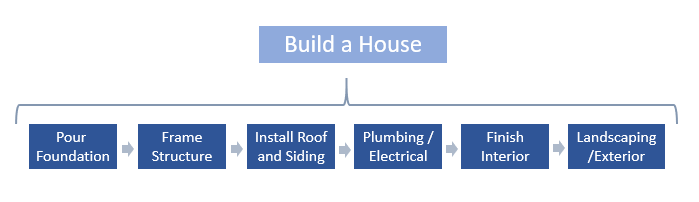
Like a task list or even a project schedule, Breaking down the big picture into sub-activities can maintain momentum (and therefore productivity) because employees can see those smaller tasks being completed. In other words, employees will continue to be motivated when the see the incremental progress.
20. Create A Work Environment Geared Towards…. Productivity
A strong correlation exists between employee productivity and their work environment. Naturally, an environment that fosters collaboration, focus, and ease of execution will encourage productivity. But there are several easily-correctable things that can deter and reduce productivity, including:
- Malfunctioning, unreliable or antiquated equipment
- Lack basic refreshments (coffee, tea, water fountains, vending machines) that let employees keep working
- Excessive noise, or lack of noise deterrents like tall cubicle walls, sound proofing, etc.
- Poor lighting
- Maintenance issues (leaky roofs, malfunctioning doors, lack of storage)
- Insufficient conference or meeting areas
- Lack of sufficient workspace (desks, work stations, offices)
- Congested shipping or loading docks
21. Build an Engaged Workforce
Finally, a softer tip for increasing employee productivity has to do with employee engagement. Employee productivity can have a lot to do with your staff’s overall job satisfaction.
In a workplace where career growth is stunted, work variety is limited, and employees do not feel they are valued, poor job satisfaction will undermine the best of any tools or systems you implement.
There are many ways to increase employee morale with your staff, so no matter which approaches you take, the most important thing is to make the effort. By enabling and encouraging employees to be at their best, you will allow them to deliver.