
The Importance of Breathing Room in Management
Learning How a Simple Game Makes for Better Business
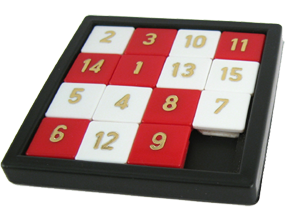
Have you ever played that children’s game of sliding tiles contained within a frame? Most of you probably have. But for those who have not, the objective of the game is to place the pieces in a specific order, perhaps arranged by color or number. What most people don’t know is this game is called the 15 Puzzle (I had to look it up) and was believed to be invented by Noyes Palmer Chapman, a postman in upstate New York, in the late 1800s (had to look that up, too).
So what does this have to do with management? Well, it is a very relevant analogy I use with new managers and business leaders when talking about how they need to run organizations their organizations. Specifically, there are three main principles that make the tile game work, which are in fact the same simple guidelines by which we manage our teams.
1. Seek Alignment and Order
The first of these principles has to do with the fact that each tile is either numbered or given some sort of specific designation – each one in unique. When looking at business and organizations at a macro level, the role of a manager is to – among many things – create alignment and order within a team to meet its objectives. The expectation of virtually every manager out there is to solve problems, maintain control and initiate selective change that leads to improvement.
Looking at this more carefully, just as in the 15 Puzzle game, each employee is different in terms of experience, skill, strengths and competencies. Further, it is the job of managers to evaluate these differences and best utilize those skills and experience in order to meet objectives. Just as in the game, once a manager or business leader sees the array of skills and knowledge, he or she can begin the practice of maneuvering and alignment in order to create an effective organization.
2. The Outside Frame
The second main principle the 15 Puzzle game gives us is the fact that the pieces are contained within a fixed space. Without this outer border, this limiting boundary, the game would simply fall apart and could not be played.
Looking at this from a management perspective, such a boundary is reminiscent of the fact that every organization and team has some level of limitation. Constraints may exist in the form of finances, people, skills, and equipment. Yet, every business leader has to find ways to work with the resources they ARE given and find ways to maneuver their people and resources within such an environment to meet their goals. Whether you are a first level manager with a handful of employees, or the CEO of a multibillion dollar enterprise, the most effective managers are those who can achieve results in situations that are less than ideal.
3. Space For Movement and Flexibility
The third, and perhaps most fundamental and important aspect of the 15 Puzzle game, is the fact that there is a single tile missing from the board. This one, limited space allows the player enough room to move pieces around to put the tiles in order. Without this space, the puzzle would be locked and the game could not be played. Equally, should more than one space in the 15 Puzzle game exist, pieces could be removed which would make the game fall apart. In other worst, too much space leads to instability.
When it comes to management, the 15 Puzzle offers a great visual means of expressing a key principle: the only way managers can truly be effective at aligning their pieces within the limitations of the organization is to be given enough space to make things happen. Empowerment.
It is for these reasons, therefore, that businesses and higher level managers need to make it a point to afford lower level managers and leaders of people some level of flexibility to make them effective, while retaining limited control to maintain a central course. In any business, a certain level of checks and balances must be present within a firm to make sure the wheels remain on the track. The question is just how much space should be given.
Empowering Managers of People
Managers and business leaders are charged with running high-performing teams with a results-oriented focus. In order to do this, managers and leaders must be empowered to make quick decisions and to have enough authority to make things happen on a daily basis.
Here are 3 simple benefits of empowering your managers:
- Speed of decisions being made for working-level staff
- When employees feel they have the ability to make decisions, it boots morale
- Managers closer to the details are in a better position to make a decision than someone further removed.
There are limitations to this, of course, as lack of oversight can lead to high impact mistakes that can harm the business. But the point still stands; for a business to be successful, the people it places in charge of achieving results must have some level of decision-making ability in order to achieve the desired objectives.
Unfortunately, when it comes to decision-making, many businesses and organizations tightly retain this authority at the top. In such cases, retaining decision-making at the top of the company often leads to delays in response as well as poorly informed decisions when higher level managers are somewhat removed from the issues at hand. Lastly, if managers in these organizations are not given authority to make basic decisions, they often find themselves feeling disengaged over time.
Ways To Evaluate The Flexibility Your Managers Have
Here are four scenarios you may want to consider.
1. Travel Expenses – Do you establish thresholds for approving business expenses, or are all expenses required to be approved by a certain individual? (Example: domestic travel under $1000 – first level managers; domestic travel of more than $1000 – second level manager; international travel – second level manager, etc)
2. Managing Metrics – As business changes over time, are your managers authorized to shift priority on metrics as appropriate? (Example: If employee A leaves the company and you need employee B to step in, can the manager use discretion in de-prioritizing other tasks that employee B had previously been working? Or must this be run through the ranks for concurrence?
3. Workforce Management – Are first-level managers allowed to increase staff based on their perceived needs with limited approval, or must all hiring decisions be made at higher levels within the organization? (Example: a manager wants to hire a temporary employee for two months to perform some administrative work. The cost can be absorbed into the manager’s budget. Is approval required?)
4. Business Operations – Do you require approvals for basic operating needs, or are these types of activities still in need of authorization? (Example: An employee’s laptop lease has expired. Is your IT support team able to outright order a new machine, or are they required to have an approval ahead of ordering the replacement?)
These may be simple examples, but the point remains the same: how much space do your managers have in order to be effective?